
America at 250 and Freedom's Journal at 200: The Unfinished Work of Freedom
By Dr. Eric M. Wallace
This year, America celebrates a remarkable milestone, its 250th anniversary. A quarter millennium ago, fifty-six men in Philadelphia put their names to a declaration that "all men are created equal" and "endowed by their Creator with certain unalienable Rights." It was a bold and audacious claim, one that changed the course of human history.
The American experiment has never been perfect, but it has been extraordinary. Over the past 250 years, the United States has become the longest-running constitutional republic in history. It has expanded liberty, defended freedom around the globe, welcomed millions seeking opportunity, and served as a beacon of hope to those living under tyranny. There is much to celebrate and much for which to give thanks to Almighty God.
Yet our national story is also one of contradiction and struggle. The same nation that proclaimed liberty tolerated slavery. The same Constitution that protected freedom required amendments to abolish human bondage and guarantee equal protection under the law. America has wrestled with its ideals from the beginning, striving to become more fully what it claimed to be.
That same struggle between promise and practice is why a second anniversary, quieter but no less instructive, deserves our attention this year.
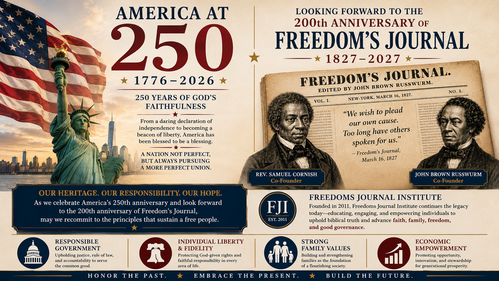
On March 16, 2027, our nation will mark the 200th anniversary of Freedom's Journal, the first Black-owned and operated newspaper in the United States. Founded by the Rev. Samuel Cornish and John Brown Russwurm, Freedom's Journal was born out of both gratitude for America's promise and frustration over its failures. The paper's founders famously declared, "We wish to plead our own cause. Too long have others spoken for us."
Their words were not a rejection of America. They were a call for America to live up to its own ideals.
The very existence of Freedom's Journal testified to the possibilities of the American experiment. Only in a nation committed, however imperfectly, to freedom of speech, freedom of the press, and freedom of religion could such a publication emerge. The newspaper challenged the nation to pursue a more perfect union while participating in the liberties that made its publication possible.
As we look back over 250 years of American history and forward to the bicentennial of Freedom's Journal, we should recognize that freedom is never self-sustaining. Every generation must renew the moral and spiritual foundations upon which liberty rests.
The threats facing our nation today are different from those of 1776 or 1827, but they are no less significant. We face a crisis of family breakdown, declining trust in institutions, rising loneliness, political division, and moral confusion. We see the erosion of the very institutions that sustain a free society— the family, the Church, and good government. For Black America in particular, the wound runs deeper still: a family structure deliberately targeted under slavery, and later strained by policies that too often rewarded its absence rather than its strength, is now being renewed—not by government, but by the same institutions that have always carried a people through hardship: family, faith, and community.
The founders understood that self-government requires self-restraint. John Adams famously observed that our Constitution was made "only for a moral and religious people." Freedom cannot endure where virtue disappears. Laws and constitutions, as important as they are, cannot substitute for character.
The family is the first school of virtue. It is where children learn responsibility, sacrifice, honesty, and love. The Church is the conscience of society, proclaiming transcendent truths and calling men and women to repentance, faith, and moral living. Good government protects liberty and promotes justice, but it cannot create virtue. It depends upon the moral formation that occurs within families and faith communities.
These institutions are not accidental products of history. They are gifts of God and essential to human flourishing.
Throughout our history, America has repeatedly experienced seasons of moral and spiritual renewal. The Great Awakenings transformed communities and strengthened the moral foundations of the republic; it was the converts of the Second Great Awakening who filled the ranks of the abolitionist movement, giving Freedom's Journal itself a moral climate in which to be born. Time and again, national renewal has been preceded by spiritual renewal.
That lesson remains as relevant today as it was two centuries ago.
As we celebrate America's 250th anniversary and prepare to commemorate the bicentennial of Freedom's Journal, we should resist the temptation either to romanticize our past or to despise it. Instead, we should embrace our history honestly and gratefully, recognizing both our failures and our achievements.
The story of America and the story of Freedom's Journal are intertwined. One reminds us that liberty is a precious gift. The other reminds us that liberty requires continual renewal and the courage to call a nation to its highest ideals.
The unfinished work of freedom now belongs to us.
Will we strengthen the family, renew the Church, and cultivate the virtue self-government requires? And will we pass on to our children not merely the memory of freedom but the character required to sustain it?
Anniversaries are more than opportunities to celebrate the past. They are invitations to consider the future.
May we be found faithful stewards of the liberty we have inherited, and may we recommit ourselves to the unfinished work of freedom—for the good of our nation and for the generations yet to come.
This year, America celebrates a remarkable milestone, its 250th anniversary. A quarter millennium ago, fifty-six men in Philadelphia put their names to a declaration that "all men are created equal" and "endowed by their Creator with certain unalienable Rights." It was a bold and audacious claim, one that changed the course of human history.
The American experiment has never been perfect, but it has been extraordinary. Over the past 250 years, the United States has become the longest-running constitutional republic in history. It has expanded liberty, defended freedom around the globe, welcomed millions seeking opportunity, and served as a beacon of hope to those living under tyranny. There is much to celebrate and much for which to give thanks to Almighty God.
Yet our national story is also one of contradiction and struggle. The same nation that proclaimed liberty tolerated slavery. The same Constitution that protected freedom required amendments to abolish human bondage and guarantee equal protection under the law. America has wrestled with its ideals from the beginning, striving to become more fully what it claimed to be.
That same struggle between promise and practice is why a second anniversary, quieter but no less instructive, deserves our attention this year.
On March 16, 2027, our nation will mark the 200th anniversary of Freedom's Journal, the first Black-owned and operated newspaper in the United States. Founded by the Rev. Samuel Cornish and John Brown Russwurm, Freedom's Journal was born out of both gratitude for America's promise and frustration over its failures. The paper's founders famously declared, "We wish to plead our own cause. Too long have others spoken for us."
Their words were not a rejection of America. They were a call for America to live up to its own ideals.
The very existence of Freedom's Journal testified to the possibilities of the American experiment. Only in a nation committed, however imperfectly, to freedom of speech, freedom of the press, and freedom of religion could such a publication emerge. The newspaper challenged the nation to pursue a more perfect union while participating in the liberties that made its publication possible.
As we look back over 250 years of American history and forward to the bicentennial of Freedom's Journal, we should recognize that freedom is never self-sustaining. Every generation must renew the moral and spiritual foundations upon which liberty rests.
The threats facing our nation today are different from those of 1776 or 1827, but they are no less significant. We face a crisis of family breakdown, declining trust in institutions, rising loneliness, political division, and moral confusion. We see the erosion of the very institutions that sustain a free society— the family, the Church, and good government. For Black America in particular, the wound runs deeper still: a family structure deliberately targeted under slavery, and later strained by policies that too often rewarded its absence rather than its strength, is now being renewed—not by government, but by the same institutions that have always carried a people through hardship: family, faith, and community.
The founders understood that self-government requires self-restraint. John Adams famously observed that our Constitution was made "only for a moral and religious people." Freedom cannot endure where virtue disappears. Laws and constitutions, as important as they are, cannot substitute for character.
The family is the first school of virtue. It is where children learn responsibility, sacrifice, honesty, and love. The Church is the conscience of society, proclaiming transcendent truths and calling men and women to repentance, faith, and moral living. Good government protects liberty and promotes justice, but it cannot create virtue. It depends upon the moral formation that occurs within families and faith communities.
These institutions are not accidental products of history. They are gifts of God and essential to human flourishing.
Throughout our history, America has repeatedly experienced seasons of moral and spiritual renewal. The Great Awakenings transformed communities and strengthened the moral foundations of the republic; it was the converts of the Second Great Awakening who filled the ranks of the abolitionist movement, giving Freedom's Journal itself a moral climate in which to be born. Time and again, national renewal has been preceded by spiritual renewal.
That lesson remains as relevant today as it was two centuries ago.
As we celebrate America's 250th anniversary and prepare to commemorate the bicentennial of Freedom's Journal, we should resist the temptation either to romanticize our past or to despise it. Instead, we should embrace our history honestly and gratefully, recognizing both our failures and our achievements.
The story of America and the story of Freedom's Journal are intertwined. One reminds us that liberty is a precious gift. The other reminds us that liberty requires continual renewal and the courage to call a nation to its highest ideals.
The unfinished work of freedom now belongs to us.
Will we strengthen the family, renew the Church, and cultivate the virtue self-government requires? And will we pass on to our children not merely the memory of freedom but the character required to sustain it?
Anniversaries are more than opportunities to celebrate the past. They are invitations to consider the future.
May we be found faithful stewards of the liberty we have inherited, and may we recommit ourselves to the unfinished work of freedom—for the good of our nation and for the generations yet to come.
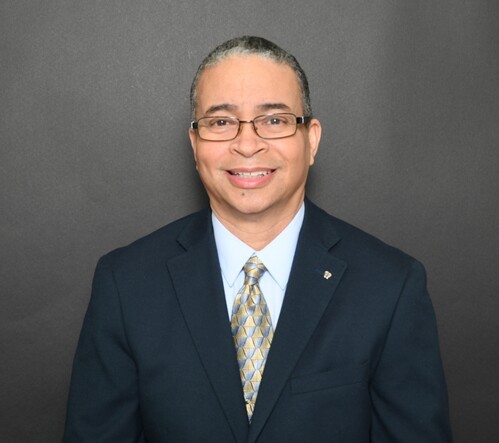
Dr. Eric M. Wallace, author of the new book, The Heart of Apostasy: How The Black Church Abandoned Biblical Authority for Political Ideology--And How to Reclaim It, is a trailblazing scholar, dynamic speaker, and passionate advocate for faith-based conservatism. With a distinguished academic background and an unwavering commitment to biblical truth, Wallace has become a leading voice challenging cultural and political narratives that conflict with a biblical worldview.
Wallace holds postgraduate degrees in biblical studies (M.A., ThM, Ph.D.), Wallace is the first African American to earn a Ph.D. in biblical studies from Union-PSCE (now Union Presbyterian Seminary). His scholarship and ministry experience equip him to address today’s most pressing sociopolitical issues through the lens of faith, reason, and historical accuracy.
Wallace holds postgraduate degrees in biblical studies (M.A., ThM, Ph.D.), Wallace is the first African American to earn a Ph.D. in biblical studies from Union-PSCE (now Union Presbyterian Seminary). His scholarship and ministry experience equip him to address today’s most pressing sociopolitical issues through the lens of faith, reason, and historical accuracy.
Posted in Opinion
Posted in Dr. Eric M. Wallace, liberty, Life, Happiness, Equality, Declaration of Independence, Fourth of July, #American People, Freedoms Journal, Creator, Church, faith, family, American History, spiritual awakening, moral fabric, celebrate, self-governance, #freedomsjournalmagazine, Freedoms Journal Institute
Posted in Dr. Eric M. Wallace, liberty, Life, Happiness, Equality, Declaration of Independence, Fourth of July, #American People, Freedoms Journal, Creator, Church, faith, family, American History, spiritual awakening, moral fabric, celebrate, self-governance, #freedomsjournalmagazine, Freedoms Journal Institute
Recent
Maybe we've become too Selfish?
August 20th, 2026
Equal Before God, Unequal in Gifts
August 20th, 2026
Beyond Personality Politics: A Biblical Framework for Evaluating Our Leaders
July 27th, 2026
The NAACP's Moral Crisis: When Civil Rights Abandons Biological Reality
July 8th, 2026
Thomas Jeremiah, America's Founding, and the Importance of Telling the Whole Story
July 7th, 2026
Archive
2026
January
March
THE GEOPOLITICAL CHESSBOARD AND THE SPIRITUAL WAR WE’RE IGNORING--Part 1THE SPIRITUAL DIMENSION AND THE CHURCH’S COMPLICITY--Part 2Racism, Sin, and the Republican Party: A Christian ResponseA Moment of Reflection on the Life of Rev. Jesse Jackson Sr.Black Americans Are Not Hyphenated CitizensWhen “Jesus Never Said That” Becomes a License for ApostasyWhen Scripture Is No Longer First: The Heart of Apostasy in the Black Church and American PoliticsDemocrats Good……Trump Bad
April
When Conviction Becomes Costly: Faith, Culture, and the Silence of the ChurchNo Savior but Christ: When Politics Crosses a Sacred LineWhat Good Is a Worldview If We Are Not Guided by It?When Resurrection Sunday Becomes Interfaith: Why the Church Must Guard the GospelSocialism in the City: When Government Tries to Play GodWords Matter: The Dangerous Illusion Behind “Mass Incarceration”More Degrees, More Debt, Less Direction: Why Illinois Is Looking the Wrong Way on Workforce DevelopmentNow, I suppose, he’s a Hitlerian KingJustice Without Partiality: What the Louisiana Ruling Reveals About America’s Heart
May
June
July
America at 250 and Freedom's Journal at 200: The Unfinished Work of FreedomThomas Jeremiah, America's Founding, and the Importance of Telling the Whole StoryThe NAACP's Moral Crisis: When Civil Rights Abandons Biological RealityBeyond Personality Politics: A Biblical Framework for Evaluating Our Leaders
2025
February
March
July
September
October
November
2024
January
Cartoon 01/01/24Cartoon 01/02/24Claudine Gay Betrayed the American Values of My Black Elders to Exploit White GuiltCartoon 01/03/24Cartoon 01/05/24Cartoon 01/06/24Cartoon 01/07/24Cartoon 01/08/24We need a David, not a SaulCartoon 01/13/24Cartoon 01/09/24Cartoon 01/10/24Cartoon 01/11/24Cartoon 01/14/24Cartoon 01/12/24What Happens to a King Deferred? A ReduxCartoon 01/15/24Cartoon 01/16/24The Good Guys with Guns Part 1Cartoon 01/17/24America Works. DEI Doesn’t.Cartoon 01/18/24Cartoon 01/23/24Good Guys with Guns Part 2Cartoon 01/19/24Cartoon 01/21/24Cartoon 01/22/24Cartoon 01/24/24Cartoon 01/26/24Cartoon 01/25/24Cartoon 01/27/24
No Comments